

Learn how casino table games work, including blackjack, roulette, baccarat, craps, bets, payouts, house edge, and how results are decided.
How casino table games work becomes much easier to understand once you look past the lights, chips, and dealer actions.
At the heart of every table game are three things: a set of rules, a way to place bets, and a method for deciding the result.
You might see players enjoying casino nights out while sitting around a blackjack or roulette table, but each game follows its own system.
Some depend mainly on cards, others use dice or a wheel, and some give players choices during a hand.
The important point is that table games are not played the same way.
Their betting options, payouts, and house advantages can differ.
The UK Gambling Commission, for example, requires licensed casinos in Great Britain to display game rules and information about the house edge.
Let’s take a closer look at what table games are.
What Are Casino Table Games?
Casino table games are gambling games played on a physical or electronic table, usually against the house rather than directly against another player.
Common examples include:
- Blackjack
- Roulette
- Baccarat
- Craps
- Casino poker variants
- Sic Bo
- Pai Gow
Different versions can have different rules and payouts.
Nevada’s Gaming Control Board, for example, maintains an official list of approved casino games that includes many blackjack, baccarat, roulette, craps, and poker variants.
This matters because the name of a game does not always tell you every rule.
A particular table may use different betting options, deck numbers, payout rules, or side bets.
How a Casino Table Game Round Works

While each game is different, most table games follow a basic sequence:
- Players choose their bets.
- The betting period closes.
- The game outcome is produced.
- The result is compared with the rules.
- Winning bets are paid and losing bets are collected.
The dealer, often called the croupier, manages the table and follows the game’s fixed procedures.
The player does not normally decide how the house handles the result.
In games such as roulette, the wheel and ball determine the outcome.
In card games, the cards determine the result according to the game’s rules.
For regulated casino equipment, random outcomes are subject to technical requirements.
The UK Gambling Commission says random-number systems must produce outcomes that are acceptably random, while physical randomization must also meet specified requirements.
How Blackjack Works
Blackjack is a card game where the basic aim is to finish with a hand value closer to 21 than the dealer’s hand, without going over 21.
A typical round works like this:
- You place your initial bet.
- You receive cards.
- The dealer receives cards.
- You may have choices such as hit, stand, double down, or split, depending on the table rules.
- The dealer then plays according to fixed rules.
- The hands are compared.
- Winning, losing, or tied bets are settled.
An ace can normally count as 1 or 11, while face cards count as 10.
One important point about blackjack is that the player has decisions to make.
That does not mean the player controls the result.
The cards still determine what happens.
How Roulette Works
Roulette works differently because players are betting on the result of a spinning wheel.
Players can place different types of bets, including:
- A single number
- Several numbers
- Red or black
- Odd or even
- Groups of numbers
After betting closes, the dealer spins the wheel and releases the ball.
When the ball settles into a pocket, the winning bets are determined by the number and color shown.
The exact wheel used matters.
Different roulette versions can have different layouts and payout structures, so checking the table rules before betting is important.
How Baccarat Works
Baccarat is mainly about betting on which hand will finish closer to a total of 9.
The common betting choices are:
- Player
- Banker
- Tie
The cards are given values, and only the last digit of the total counts.
For example, a hand worth 15 has a baccarat value of 5.
Unlike blackjack, players normally do not decide whether another card should be drawn.
The drawing rules are built into the game.
That makes baccarat a useful example of how casino table games work differently.
The player is mainly choosing which outcome to bet on, rather than controlling the play of the cards.
How Craps Works
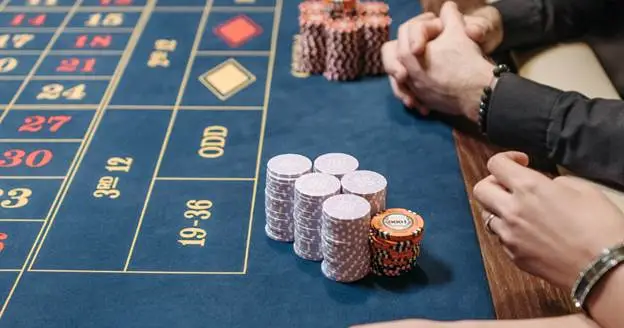
Craps uses dice rather than cards or wheels.
Players place bets on possible results of dice rolls.
One common bet involves the Pass Line, where the result of the rolls determines whether the wager wins or loses under the game’s rules.
Craps can look complicated because the table contains many betting areas.
Some bets depend on one roll, while others can remain active across several rolls.
This is why reading the specific table rules matters before placing a bet.
What Is the House Edge?
The house edge is the mathematical advantage built into a casino game.
It does not mean the casino wins every round.
A player can win several rounds in a row.
Instead, the house edge represents the casino’s expected advantage over many plays under the stated rules.
The UK Gambling Commission describes house edge as a measure of the percentage a casino would expect to keep, on average, from a game over repeated play.
Research explains that house edge represents the gambling operator’s advantage and is normally expressed as a percentage.
A short winning session does not change the underlying mathematical structure of the game.
Conclusion
Understanding how casino table games work comes down to knowing the relationship between your bet, the game rules, the random outcome, and the payout.
Blackjack gives players decisions during a hand.
Roulette uses a wheel and ball.
Baccarat uses fixed drawing rules.
Craps uses dice and several types of wagers.
The house advantage is built into the mathematics of the game, while individual results can still vary from round to round.
Before playing, reading the table rules and payout information gives you a much better idea of what each wager means.